


Friend
Professional
- Messages
- 2,677
- Reaction score
- 1,074
- Points
- 113
Cybercriminals attack the company's reputation by playing noble avengers.
According to Sophos, cybercriminals are constantly improving their methods of exerting pressure on victims. Over the past 3 years, the tactics of ransomware operators have changed significantly, and the threats are becoming more sophisticated and dangerous.
In 2021, Sophos published a list of 10 main ways that ransomware operators increase pressure on their victims. These include threats to publish stolen data, calls to employees, and notifications to customers and the media about violations. After 3 years, such methods are still used, but new ones have emerged that cause serious concerns.
One of the most disturbing trends is the use of legitimate institutions (the media, legislative bodies, and law enforcement agencies) as a tool of blackmail. Criminals push aggrieved customers and employees to file lawsuits against companies, sometimes even providing contact details of managers to increase the pressure.
Another new tactic is the use of stolen data to search for evidence of illegal activity or non-compliance with legal requirements. This data is then used to further blackmail and damage the reputation of victims. For example, one of the ransomware groups said that it conducts a "criminal legal assessment" of stolen data in order to identify violations and use them as leverage.
Of particular note are cases where attackers seek to discredit their victims by accusing them of unethical or negligent behavior. Such actions are aimed at causing reputational damage, as well as creating an image of criminals as "noble avengers" who allegedly expose corruption and crimes.
Some ransomware groups go even further, threatening to publish highly sensitive data, including medical records, intimate images, and even the personal details of executive family members. In one of the cases, the criminals published the identification documents of the daughter of the company's CEO, as well as a link to her social network profile.
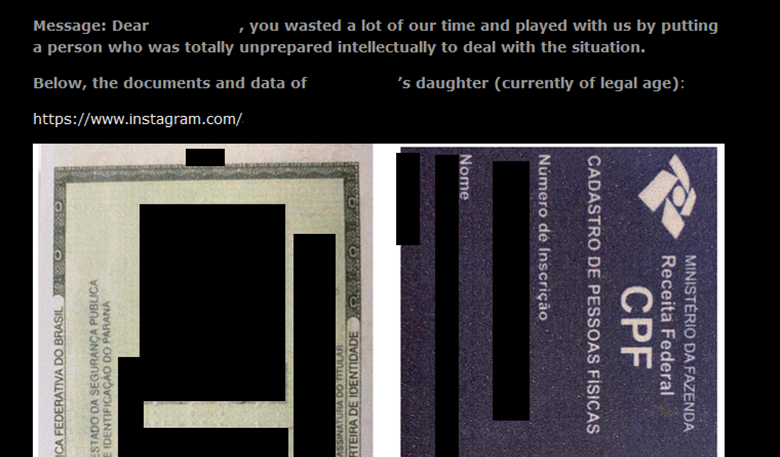
Personal data of the CEO's daughter
Threats to publish confidential data are accompanied by intimidation and even direct threats of physical impact. So, in one of the cases, malefactors threatened clients of an oncological clinic with so-called swatting — a false call of special services to the victim's address, which can lead to serious consequences, up to the death of people.
The situation is compounded by the fact that many criminals seek to use any available legal means to achieve their goals. They not only threaten their actions, but also actively draw attention to cases of non-compliance with legal requirements in order to increase pressure on companies and force them to pay a ransom.
Thus, there is an escalation in the tactics of cybercriminals, who are increasingly moving beyond the digital space and beginning to use real threats to achieve their goals. Unfortunately, the probability that such methods will be improved in the future remains high.
To protect against such threats, Sophos experts recommend using advanced security techniques, as well as seeking professional help in the event of an attack. Data protection and maintaining the reputation of companies in the face of growing threats are becoming a priority for all organizations facing cyber threats.
Source
According to Sophos, cybercriminals are constantly improving their methods of exerting pressure on victims. Over the past 3 years, the tactics of ransomware operators have changed significantly, and the threats are becoming more sophisticated and dangerous.
In 2021, Sophos published a list of 10 main ways that ransomware operators increase pressure on their victims. These include threats to publish stolen data, calls to employees, and notifications to customers and the media about violations. After 3 years, such methods are still used, but new ones have emerged that cause serious concerns.
One of the most disturbing trends is the use of legitimate institutions (the media, legislative bodies, and law enforcement agencies) as a tool of blackmail. Criminals push aggrieved customers and employees to file lawsuits against companies, sometimes even providing contact details of managers to increase the pressure.
Another new tactic is the use of stolen data to search for evidence of illegal activity or non-compliance with legal requirements. This data is then used to further blackmail and damage the reputation of victims. For example, one of the ransomware groups said that it conducts a "criminal legal assessment" of stolen data in order to identify violations and use them as leverage.
Of particular note are cases where attackers seek to discredit their victims by accusing them of unethical or negligent behavior. Such actions are aimed at causing reputational damage, as well as creating an image of criminals as "noble avengers" who allegedly expose corruption and crimes.
Some ransomware groups go even further, threatening to publish highly sensitive data, including medical records, intimate images, and even the personal details of executive family members. In one of the cases, the criminals published the identification documents of the daughter of the company's CEO, as well as a link to her social network profile.
Personal data of the CEO's daughter
Threats to publish confidential data are accompanied by intimidation and even direct threats of physical impact. So, in one of the cases, malefactors threatened clients of an oncological clinic with so-called swatting — a false call of special services to the victim's address, which can lead to serious consequences, up to the death of people.
The situation is compounded by the fact that many criminals seek to use any available legal means to achieve their goals. They not only threaten their actions, but also actively draw attention to cases of non-compliance with legal requirements in order to increase pressure on companies and force them to pay a ransom.
Thus, there is an escalation in the tactics of cybercriminals, who are increasingly moving beyond the digital space and beginning to use real threats to achieve their goals. Unfortunately, the probability that such methods will be improved in the future remains high.
To protect against such threats, Sophos experts recommend using advanced security techniques, as well as seeking professional help in the event of an attack. Data protection and maintaining the reputation of companies in the face of growing threats are becoming a priority for all organizations facing cyber threats.
Source
