

Lord777
Professional
- Messages
- 2,578
- Reaction score
- 1,532
- Points
- 113
Now the user can watch the video without turning it on.
Google continues to improve its Bard chatbot. Particular attention is drawn to a recent update that provides Bard integration with YouTube. Now Bard is able to analyze videos, highlighting key information, and the user does not even need to click on the video playback button. The innovation promises to be a powerful tool, but it also raises questions about the impact of generative AI on content creators.
To test the effectiveness of Bard, a video with a cocktail recipe was selected. Bard unmistakably extracted the exact ingredients, their dosages, and cooking instructions from the video. The only slight deviation was the recommendation to shake the drink for 30 seconds, which was not in the original video. Nevertheless, the results of Bard's work can be considered successful.
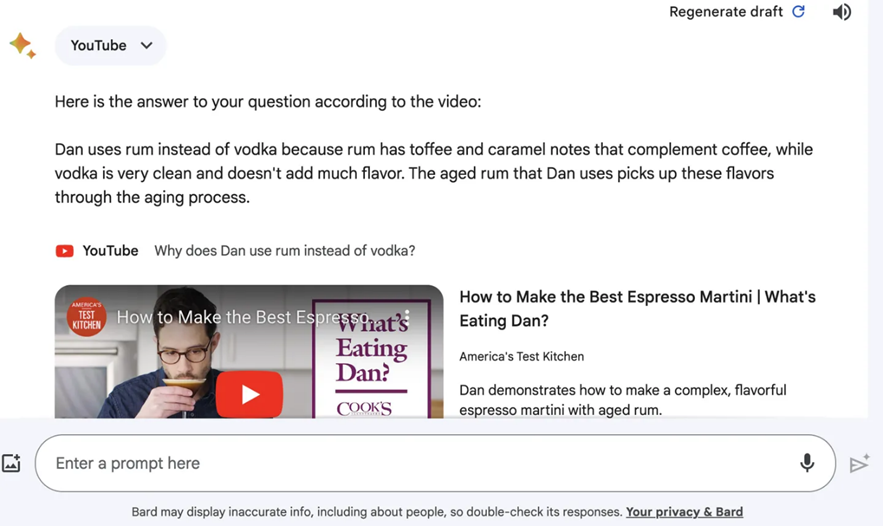
Bard described the main points from the video with the cocktail recipe
However, there is a problematic point. The recipe is already published on the site of the video source, and access to it is limited to a subscription. When using Bard to get a recipe from a video, the user bypasses viewing the video on YouTube, including the preview video at the beginning and other recommended videos at the end, which potentially reduces the revenue from the author's content.
Currently, the feature is only available as an optional experiment within Google Labs. Some difficulty in getting a response limits the risk to the authors of YouTube videos. For example, a direct request for "full recipe" from a video failed, while a request for "step-by-step instructions" was successful.
In the future, we can expect to integrate such a tool directly into YouTube, which will spark a new discussion about how content authors can benefit from using Bard to analyze their videos. At the moment, the only obvious beneficiary is Google. The problem is not new to the field of generative AI, and the industry as a whole, including Google, has not yet found a solution. Google did not provide a comment on this issue.
Google continues to improve its Bard chatbot. Particular attention is drawn to a recent update that provides Bard integration with YouTube. Now Bard is able to analyze videos, highlighting key information, and the user does not even need to click on the video playback button. The innovation promises to be a powerful tool, but it also raises questions about the impact of generative AI on content creators.
To test the effectiveness of Bard, a video with a cocktail recipe was selected. Bard unmistakably extracted the exact ingredients, their dosages, and cooking instructions from the video. The only slight deviation was the recommendation to shake the drink for 30 seconds, which was not in the original video. Nevertheless, the results of Bard's work can be considered successful.
Bard described the main points from the video with the cocktail recipe
However, there is a problematic point. The recipe is already published on the site of the video source, and access to it is limited to a subscription. When using Bard to get a recipe from a video, the user bypasses viewing the video on YouTube, including the preview video at the beginning and other recommended videos at the end, which potentially reduces the revenue from the author's content.
Currently, the feature is only available as an optional experiment within Google Labs. Some difficulty in getting a response limits the risk to the authors of YouTube videos. For example, a direct request for "full recipe" from a video failed, while a request for "step-by-step instructions" was successful.
In the future, we can expect to integrate such a tool directly into YouTube, which will spark a new discussion about how content authors can benefit from using Bard to analyze their videos. At the moment, the only obvious beneficiary is Google. The problem is not new to the field of generative AI, and the industry as a whole, including Google, has not yet found a solution. Google did not provide a comment on this issue.

